 © Cig Harvey
Cig Harvey
© Cig Harvey
Cig Harvey
Cristina de Middel
GENTLEMEN’S CLUB
 © Cristina de Middel
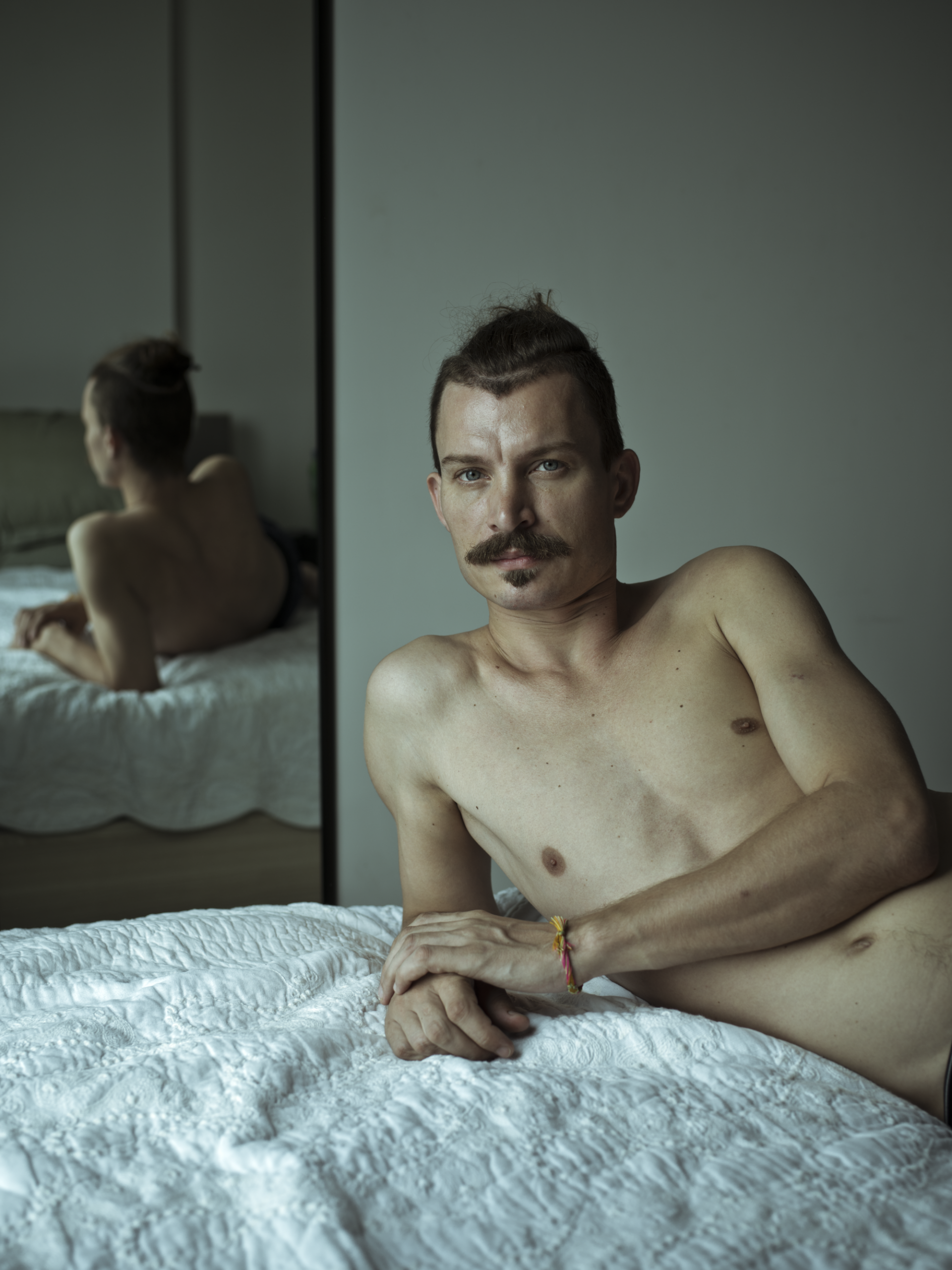
 What do we know about the men who pay for sex? Public narratives around prostitution have traditionally focused on women: on questions of exploitation and autonomy, violence and survival, trafficking and labour. The other half of the transaction – the client – has remained curiously absent from view. He is often reduced to a type, a moral category, or simply left outside the frame. In Gentlemen’s Club, Cristina De Middel turns her attention towards this absence. The project began with a deceptively simple question: what happens in the mind of a man who decides to pay for sex? Rather than approaching the subject through judgement or predetermined conclusions, De Middel uses the method that has shaped much of her practice: curiosity. Over several years, she sought out and photographed men who had paid for sex, working across different countries and cultural contexts. The project began in Brazil and subsequently expanded to Cuba, Thailand, India, Mexico, the United States, and other locations, gradually building an archive in which geography changes but many of the underlying questions remain remarkably persistent. The encounter itself is central to the work. De Middel is not an invisible observer. She is a woman standing behind a camera, asking men to speak about sex, desire, money, intimacy, and shame. This reversal of the conventional gender dynamic gives the portraits a particular tension. The men are accustomed to occupying the position of the client – the person who chooses and pays to look, touch, or possess a temporary experience. In De Middel’s photographs, they become the ones being looked at. The camera subtly redistributes power. Yet De Middel does not use that reversal to expose or humiliate her subjects. Instead, the photographic session becomes a negotiation: between photographer and sitter, woman and man, visibility and concealment, curiosity and self-protection. The men decide how much of themselves they are willing to reveal, while De Middel decides how that revelation enters the image. For some, that negotiation ends in anonymity. Faces disappear behind shadows, objects, gestures, or the architecture of the frame. Sometimes concealment responds to the sitter’s need not to be recognised; but within the series, anonymity acquires a broader meaning. A hidden face denies us the satisfaction of believing that a portrait can fully explain the person before us. We see a body, a room, a posture, perhaps an expression partially withheld – and are forced to confront how quickly we construct a character from fragments. In this sense, what remains invisible is as significant as what the photograph reveals. The testimonies deepen this uncertainty. De Middel spoke with more than a hundred men about their motivations, desires, loneliness, relationships, fantasies, and contradictions. What emerged was not a single portrait of the client, but the impossibility of one. There is no representative man here. The accounts resist the reassuring simplicity of stereotypes. Desire intersects with loneliness; power with vulnerability; intimacy with transaction; shame with the need to speak. The project gradually moves beyond prostitution towards a broader and more uncomfortable territory: masculinity, emotional isolation, and the limited space men are often given – or give themselves – to articulate vulnerability. “They were talking about sex to me,” De Middel recalled. “They were confessing.” The word is important. Confession requires vulnerability, but it also requires someone willing to listen without immediately deciding what that confession means. In this sense, listening becomes as important as photographing. This shift gives Gentlmen’s Club an unusually personal position within De Middel’s practice. Years earlier, she had spent three years working with a sex worker on The Life and Miracles of Paula P. She felt she had encountered prostitution from one side, while the other remained largely incomprehensible to her: “I still didn’t understand what was happening in the man’s brain.” The question was not purely intellectual. As a teenager, De Middel survived sexual abuse, an experience that had profoundly affected her perception of men. Through the conversations that formed Gentlemen’s Club, something she had not anticipated began to happen. “I realised I had a very distorted image of men,” she says. “It helped me understand them. It helped me humanise this part of men.” Humanising does not mean forgiving. Nor does it mean excusing behaviour or erasing responsibility. It means resisting the comfort of turning people into symbols. “I realised I was healing.” What began as an investigation of an overlooked social group thus became, unexpectedly, a process of self-examination. For a photographer who had long used the camera as a means of questioning the world, Gentlemen’s Club became a way of questioning – and transforming – her own assumptions. Such reversals are characteristic of De Middel’s practice. From The Afronauts onwards, she has repeatedly challenged documentary photography’s claim to certainty. Her work moves between fact and fiction, evidence and imagination, asking not only what photographs show, but what expectations we bring to them. For De Middel, documentary is not a machine for producing definitive answers. It is a space in which familiar narratives can be destabilised. Gentlemen’s Club preserves that instability until its final gesture. Among more than a hundred genuine testimonies, De Middel introduces one fictional participant – an actor performing what she describes as a “Pretty Woman kind of a story”. “I always need one last step,” she says. “One last smile.” The intervention is small but significant. Fiction does not enter the project to invalidate its documentary foundation, nor simply to deceive the viewer. It introduces doubt into a structure that might otherwise appear complete. Every testimony, after all, is shaped by memory, self-perception, omission, and performance. Every portrait contains both what is shown and what remains inaccessible. Humour, irony, and fiction recur throughout De Middel’s work precisely at moments when certainty seems most tempting. The smile is not an escape from the seriousness of the subject. It is a way of keeping interpretation open. Gentlemen’s Club does not ask us to forgive, condemn, or identify with the men it portrays. Nor does it promise that looking more closely will produce a simple truth. It asks for something more difficult: to look at someone whose face may remain hidden, to listen without immediately passing judgement, and to resist reaching a conclusion too quickly. Perhaps that is where curiosity becomes empathy – not in agreement, but in allowing another person to remain complicated.
More exhibitionsAll exhibitions →