 © Kateřina Sýsová
Multiple authors
© Kateřina Sýsová
Multiple authors
Sanne de Wilde
THE ISLAND OF THE COLORBLIND
 © Sanne de Wilde
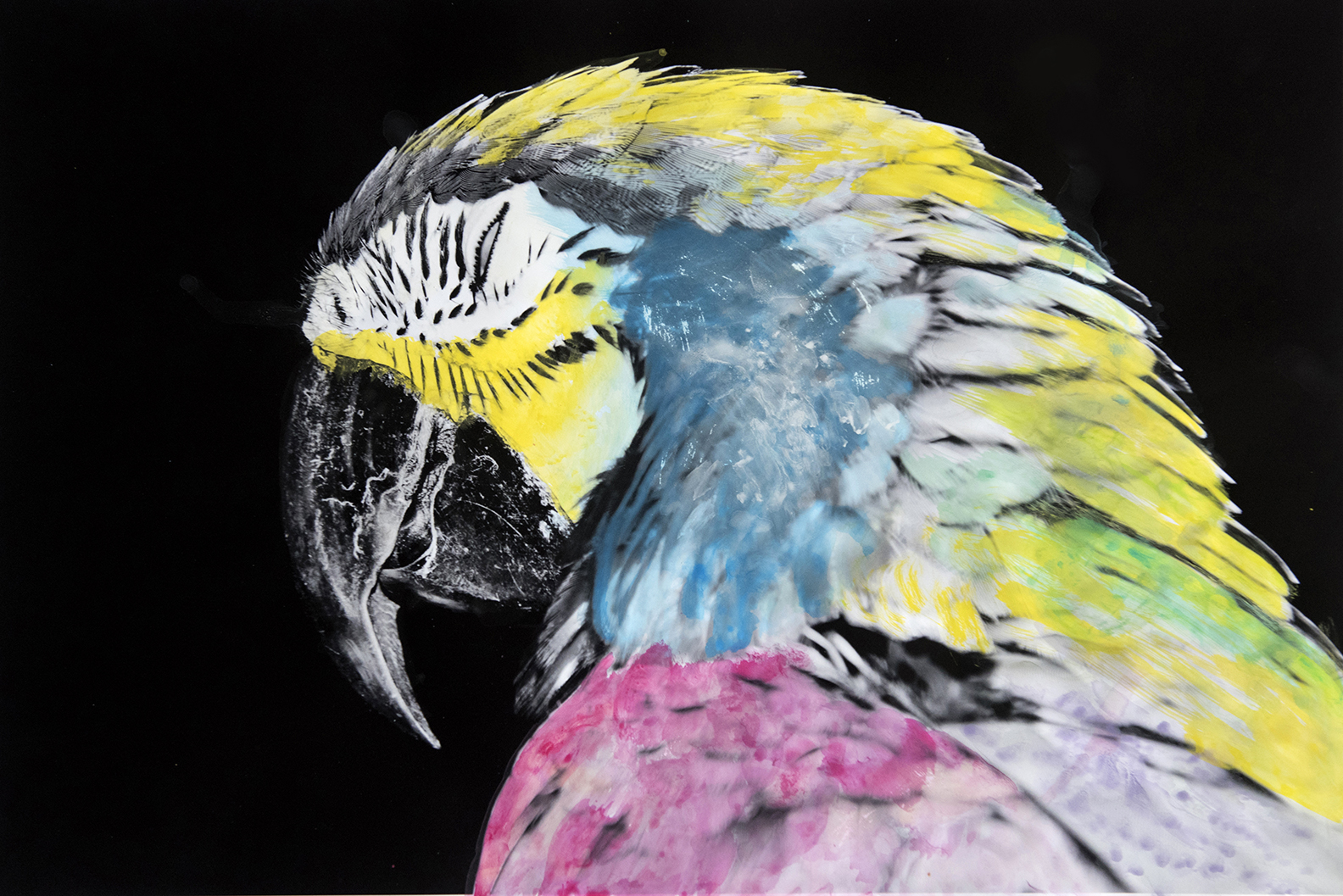
 There is something unsettling about entering these images. A tropical landscape is before us, yet it refuses the colours we expect from it. Leaves burn pink and white. Bodies emerge from darkness. Faces are interrupted by shadows, gestures, leaves, hands. Eyes close against the light. At moments, the photographs seem almost hallucinatory; at others, strangely quiet. We recognise the world, and yet something in it has shifted. The Island of the Colorblind begins with a question that photography cannot really answer: How does another person see? Sanne De Wilde travelled to Pingelap, a small atoll in the Pacific where an unusually large proportion of the population lives with achromatopsia, a rare hereditary condition that affects colour perception and causes acute sensitivity to light. Its presence on the island can be traced back through generations, becoming part of Pingelap’s history and collective memory. But De Wilde was drawn not simply to a genetic condition. She was interested in the invisible inheritance carried by bodies, and in the way a biological difference can shape a person’s relationship to the world. Gradually, the project became an exploration of something more elusive: the instability of perception itself. Photography would seem to be the perfect medium for such an investigation. Photography is made from light. It promises to show us what was there. And yet, on Pingelap, light becomes unreliable. The brilliant tropical sun can overwhelm rather than illuminate. Eyes close against it. Faces turn away. People seek shade. As daylight fades, the world may become easier to navigate. The familiar equation – more light means more visibility – is quietly overturned. De Wilde allows this contradiction to enter the photographs themselves. She moves between black-and-white, infrared photography, and images altered by hand. She chose to work with an infrared camera she had never used before, deliberately giving up a measure of control. The camera could record colours she herself could not anticipate. The photographer, too, had to enter a world in which the familiar relationship between seeing and knowing had become uncertain. And so the island becomes strange. Vegetation glows. Skin changes temperature. Familiar colours disappear and impossible ones arrive. The landscape oscillates between something earthly and something imagined. Looking at these photographs, we hesitate. Are we seeing more, or less? The images do not attempt to reproduce another person’s vision. Such a translation could never be exact. Instead, they create a space of uncertainty – a place somewhere between observation and imagination, between what the camera records and what the mind expects to see. Perhaps this is why the photographs feel less like documents than memories or dreams. We look for information, but encounter atmosphere. We look for faces, but eyes disappear. We expect the lush colours of a Pacific island, but colour becomes unstable: sometimes absent, sometimes excessive, sometimes almost supernatural. There is beauty here, but also discomfort. The photographs seduce us while denying us certainty. Gradually, the viewer becomes conscious of something normally forgotten: the act of seeing. We begin to notice our own eyes. We become aware of how automatically we trust them. A leaf is green. The sea is blue. A flower is red. We speak as though these colours belonged unquestionably to the objects themselves. But the photographs loosen this certainty. They remind us that colour does not exist for us independently of perception; it is something produced in the encounter between the world, the eye, and the mind. De Wilde extends this uncertainty through collaboration. People from Pingelap were invited to paint onto black-and-white photographs without knowing which colours they were using. Colour returns to the image not as optical truth, but through gesture, memory, language, and imagination. There is something quietly beautiful in this act. Colour can exist even when it is not perceived in the way most of us assume. It has names. It carries associations. It can be described by someone else. It can be remembered as an idea. It can be imagined. The resulting photographs hover somewhere between seeing and knowing. And perhaps this is where The Island of the Colorblind slowly reverses our position as viewers. At first, we may think we have come to look at people who see differently. But the longer we remain with the images, the more that distinction begins to dissolve. The question is no longer: What is absent from their vision? It becomes: What are the limits of ours? We cannot step inside another person’s eyes. We cannot know whether two people experience the same red, the same darkness, the same intensity of light. We inhabit a shared world while carrying private versions of it within us. Photography cannot close this distance. But it can make us feel it. For a moment, before these strange trees, disappearing faces, and luminous bodies, the visible world loses its certainty. Colour becomes mysterious again. Light becomes something we cannot entirely trust. And seeing – something we do thousands of times each day without thinking – becomes an act of imagination. Jana Rajcová
More exhibitionsAll exhibitions →
© Kateřina Sýsová
Multiple authors
 © Ivan Kováč
Ivan Kováč
© Ivan Kováč
Ivan Kováč
TRUTH-LIKELY PEOPLE
 © Karol Kállay
Karol Kállay
© Karol Kállay
Karol Kállay