 © Cristina de Middel
Cristina de Middel
© Cristina de Middel
Cristina de Middel
Jozef Sedlák
Things in the Hidden Image
 © Jozef Sedlák
 In his current exhibition project, Jozef Sedlák explores the genealogy of the medium of photography through experiments with the photographic image, approaching it on various levels as a historical and transcendent journey of the analogue image of the world and the human being as pictorial memory – an archive. For the viewer, it is almost impossible to separate the ambivalence of the artistically stylised image from the sociological semiotics of pure photography. The exhibition thus presents a philosophical and technological approach to working with the image, offering relevant insight into a return to the roots of the photographic medium.
The project Latency I (2011) brings together layers of memory and reflections on the meaning, essence, and principles of existence. The artist leads us “behind” the silver-sensitive layer towards the utterly purified philosophical plane of the so-called latent image and the metaphysical capacities of photography. Jozef Sedlák is concerned not only with the technological and experimental possibilities of photography; through the medium of photography, he also addresses universally valid questions concerning the meaning of human existence, death, and the fate of the human being and the world. The central motif consists of large-format negatives measuring 70 × 100 cm, which, through direct contact exposure, create a so-called surface latent image on traditional baryta photographic paper using natural light in the exhibition space. The story of physical transformation is at the same time a record of the concept of processual art, articulated through the disappearance of the work itself. The difference is that while interaction with the viewer transforms the latent image in real time, the actual, frozen story recorded in the photographs has long since passed; what remains is the fleeting fluidity of the invisible, yet already existing, image. Jozef Sedlák takes the project further, into the factual realm of a rediscovered archive and personal artefacts from an estate. He incorporates scanned original objects and photographs and, together with digital photographs, creates an imaginary mosaic of the archive and a metaphorical map of portraits, objects, as well as room and house furnishings.
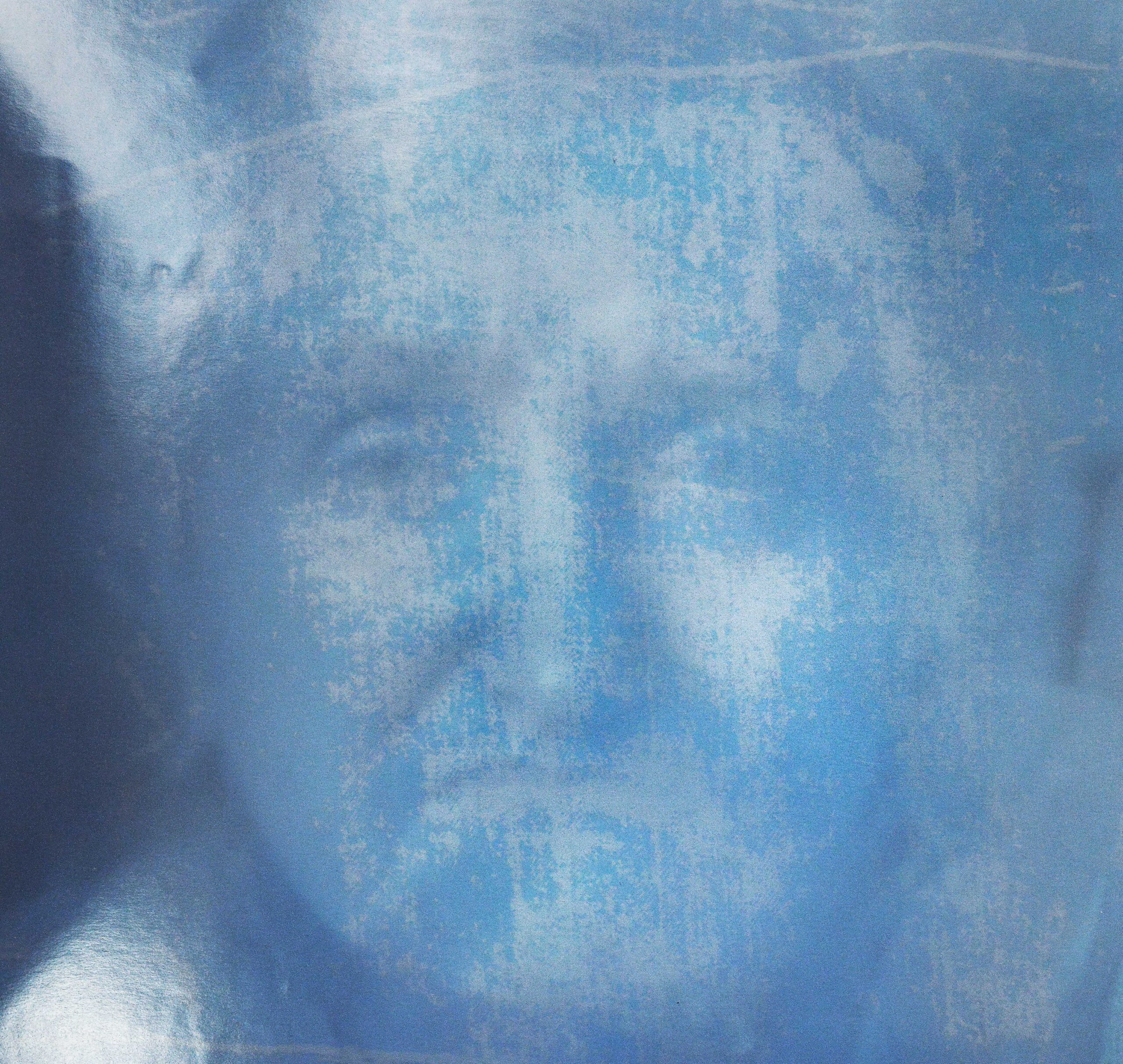
The project Under the Face (2016) is a spatial photographic installation combining large-format digital prints (reproductions of latent portraits). The installation consists of eight objects – tables with hinged tops. The top of each table is formed by a large-format plexiglass negative featuring portraits of people close to the artist. On the surface of each table, the face of Christ from the Turin Shroud has previously been exposed onto traditional photographic paper through the process of creating a latent image. The image is revealed to the viewer when the top of the table is opened. Natural light gradually illuminates the portraits of the people – through the repeated lifting of the table top, the flow of light, and the contact between the plexiglass and the photographic surface – initiating a double exposure of the face from the Turin Shroud with the face of the respective person. The sharpness and legibility of each latent “photomontage” (the face of Christ and the human face) depend on the intensity of the light, the duration of exposure, and the repeated lifting of the negative cover. This ongoing process of latent images becomes a memento of pictorial metanoia – a personal journey and memory – while the disturbing hybrid portraits become both a nihilising and a redemptive factor.
The cycle Latency II (Postcards from New York City) (2001–2011) is presented as a spatial installation in wooden cases hung on the wall or placed on easels, with traditional photographic paper at the bottom and a negative positioned in the upper cover of the frame. Through the viewer’s repeated opening of the upper panel and the action of light, the negative image is gradually transferred onto the positive photographic surface.
Through the repeated manual lifting of the negative image, the viewer becomes an inseparable part of this processual work, dissolving into it, because without the viewer the work would not exist. The cases contain documentary photographs whose visual character is both provocative and mutable, giving us the impression that the latent image itself is no longer sufficient, even though it is precisely this image that is responsible for the shift towards a metaphor of attack.
The photographs were taken in New York State three months before the terrorist attack on the Twin Towers. The visually clear photographic documentary captures everyday life in New York, which the artist appropriates as part of the spatial installation. The latent image symbolises the reality and situations preceding the attack on the Twin Towers and modulates the weapon not merely as a programme of a virtual game, but as an evolving and constantly threatening potential danger. Through framing and shifting into the latent plane of the image, banal street scenes become a memento of respect for the wound inflicted on collective memory, while at the same time becoming a nihilising factor in relation to the supposedly meaningful aspects of everyday life.
We cannot, however, claim that Jozef Sedlák is playing with us on a perceptual level, because he is an author of truth and direct, sincere self-reflective analysis. In the current exhibition project, he is also a visual chronicler of the history of photography. The concept of the exhibition is subordinated to the artist’s intentions, which smoothly transcend the dialectic of time by interweaving the analogue and digital properties of the photographic medium.
Jozef Sedlák returns to the theme of the latent image and its philosophical dimension throughout his work, approaching it in various contexts. At times, he adopts an ethically evaluative perspective on broader social phenomena; at other times, he reaches into the intimate sphere of the family album, allowing us, through historical portraits, to glimpse the temporal record of particular human destinies.
In this way, the meaning of the latent image becomes intertwined, both analogically and comparatively, with the preciousness of “possible seeing”, while the viewer becomes, to a certain extent, the creator of what is to become visible and, conversely, of what is to remain hidden within the layers of silver compounds.
Just as ephemerality itself is inscribed in what is physically still “unseen” or “invisible”, this visual oxymoron – “eloquent silence” – is inscribed in the very story of the history of photography.
More exhibitionsAll exhibitions →
© Cristina de Middel
Cristina de Middel
 © Andrej Balco
Andrej Balco
© Andrej Balco
Andrej Balco
Weary of the Sun