 © Miro Švolík
Miro Švolík
© Miro Švolík
Miro Švolík
John Demos
Panigiria
 © John Demos
 Héliogravure by Fanny Boucher
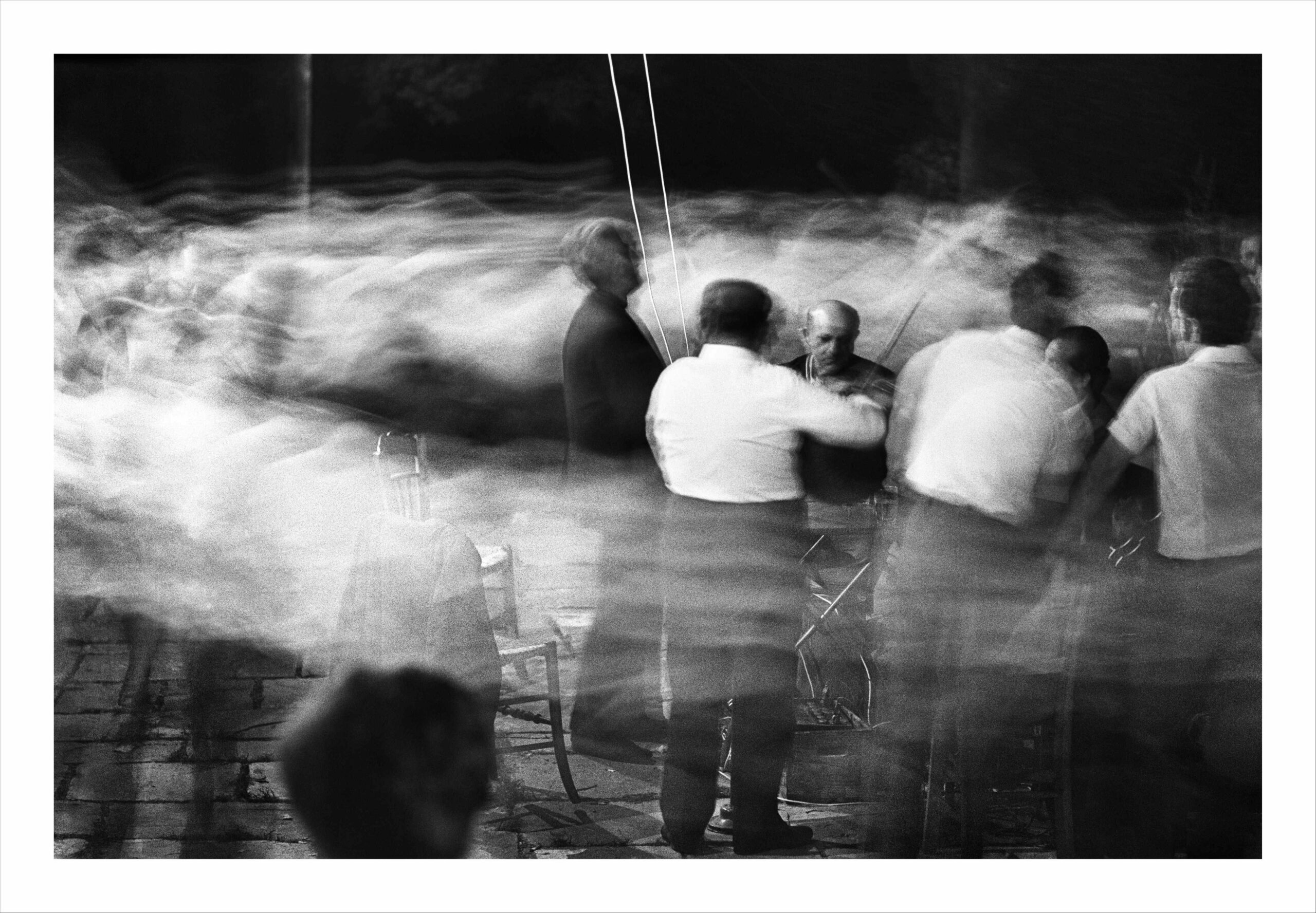
The photographs at the end of John Demos book The Greece that is Passing are in marked contrast to those before – and provide a key to the artist’s later work. The photographs do not freeze motion. Rather, they allow motion to take over. This was the impetus for The Panigiria Series. The photographs are on the theme of Panigiria. This is a particular form of rite unique to Greece, usually taking place on various saints’ days of the Orthodox church. Demos is drawn again and again, to recording – some might say interpreting – his vision of “The Greece that is Passing”.
The last photograph, Papingo, 1975, is of a surreal dance, where light and movement become one. The figures whirling around a group of musicians – taken at slow shutter speed – become unrecognizable as people. Instead, they appear more as essences. They become the dance. And as Yeats wrote: “Who can tell the dancer from the dance?” The critic, John Berger, has observed that a photograph is a “memento from a life being lived.” Taken at face value, this notion intrigues; but coupled with Demos most controversial – and successful – work, the Panigiria series, the idea of “life being lived” assumes a vivid pan-dimensional authority.
The series worked on from 1975–1994 has a unique personal resonance for Yiannis Demos. He discovered that only after the music had captured him, he could capture the dance. “In my best work, he says, “the music was doing the same thing to me photographically as it was to the people dancing. It was the music that was producing the photographs.” There is a dimension to Demos’ work in the sequences that borders on the metaphysical, something to which, with reservations, he admits: “I want to record the blur, the evanescence. But more than that, I want to induce a feeling in the viewer – and here it gets difficult – of a sense of something leading towards the mystical.”
And the nighttime – when Panigiria take place – holds its own special fascination for the photographer. “At night, in the darkness,” he says, “I love the point at which things come into existence and things disappear.” “What really interests me is the light,” Demos asserts – a claim which, looking at his work, would be difficult to refute. “Light is important to me,” he grins cryptically, “if only through darkness. Because I’m interested in how light surfaces from the dark. I want the glow to come from within the composition of my subjects”.
The theme of transience in the series is considerably more profound than that expressed in his earlier work – as if he has finally confronted his past and is now examining the very essence, rather than the substance of things passing. The Panigiria series is simultaneously a metaphysical treatise and a plea for spiritual temporal sanity. The metaphysics spark from the unearthly images of people – twirling in a spectral dance – as essences; the plea for sanity by the photographer’s understanding of time passing. “Every instant,” Demos says, “the world is being created and every instant the world is being destroyed. As a photographer you either catch it, or you don’t.”
But, although Demos’ work is fundamentally inspirational, it requires phenomenal reserve. “He’s fascinating to watch,” observes a close friend, poet Don Scofield. “His powers of concentration are amazing – he’s always alert.” To which Demos replies. “Things happen constantly, I’m just trying to make connections. And to be honest, I don’t know how much significance there is in the world. It’s not ready made for you.”
Mark Mallett, The Athens Star, 1986
The Panigiria in Zagori
Since the dawn of humanity, a community’s identity and the place to which it belongs have been intrinsically linked with ritual acts. The Greek panigiri, feasting and dancing in honour of a holy figure, is the direct descendant of such rituals. The subject of Demos’s photographs in this series is specifically the panigiria of Zagori, a cluster of small mountain villages in Epirus, NW Greece.
Sometimes, Demos’s long exposures make the dances disappear in a haze of abstraction, sublimating the slow-moving group into a bright halo encircling the musicians beneath the churchyard tree – a setting resonant of those earliest of times before architecture, when trees marked the sacred place for humanity’s rituals. Other times, Demos’s fast-shutter shots focus on individual dancers and musicians, whose moments of festive rapture are translated into compositions of such intensity, they become Mannerist paintings of agony and ecstasy.
These different rhythms of photographic action and imagery are composed together as fragments of a plot or perhaps traces of a memory, hinting at a profound significance that remains tantalisingly near yet always elusive, beyond the frame.
Alexandra Stara
More exhibitionsAll exhibitions →
© Miro Švolík
Miro Švolík
 © Karol Kállay
Karol Kállay
© Karol Kállay
Karol Kállay
ZDENKA
 © Josef Sudek
Josef Sudek
© Josef Sudek
Josef Sudek