 © Ivan Kováč
Ivan Kováč
© Ivan Kováč
Ivan Kováč
Roman Vondrouš
HOT BALLS
 © Roman Vondrouš
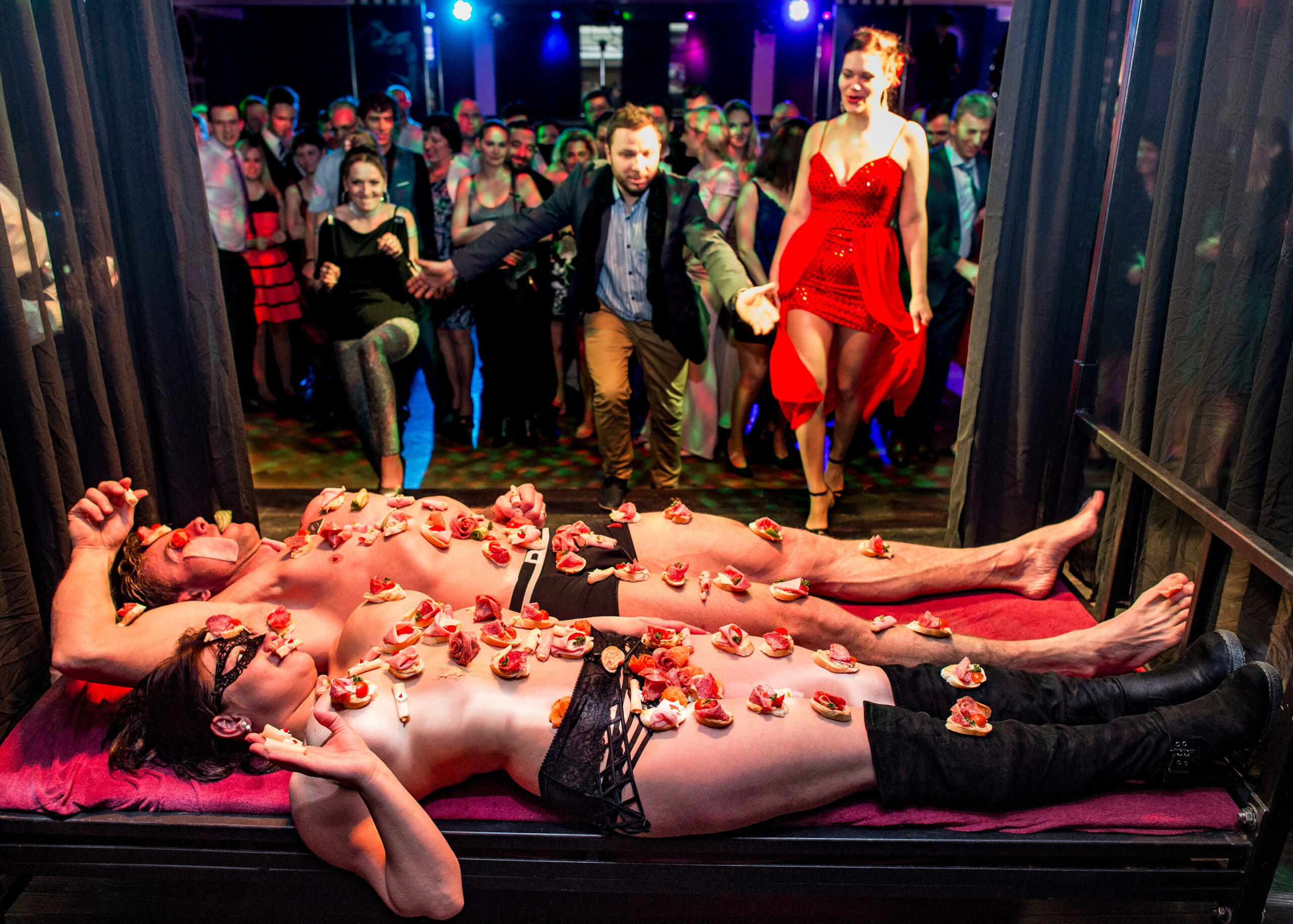
 Photographer Roman Vondrouš is one of the most prominent figures in contemporary Czech documentary photography. He has worked as a photojournalist for many years and has received international recognition, particularly for his images from the world of horse racing, for which he was awarded the prestigious World Press Photo Award. In addition to news photography, he is systematically engaged in long-term authorial projects. The Hot Balls series is having its world premiere at the Month of Photography festival in Bratislava. Since 2017, Vondrouš has been attending and photographing erotic balls in various cities across the Czech Republic. The photographs were taken in Bílin, Chlumec near Ústí nad Labem, Liberec, Turnov, Česká Lípa, Mladá Boleslav, Pardubice, and Ostrava. They capture a phenomenon that, despite its long history, remains on the fringes of public attention – a distinctive form of social entertainment combining the traditional rituals of a ball with erotic performance. The author continues the tradition of Czech documentary photography, which, after 1989, began to focus more intensively on issues of sexuality and social transformation. In this context, the series can also be read as a free continuation of the visual interest in the phenomena of post-socialist freedom and new forms of entertainment. Erotic balls become an image of a society that, after the fall of the totalitarian regime, discovered previously suppressed forms of public intimacy, consumerism, and the entertainment industry. At first glance, the photographs might appear to have been taken in the 1990s. The interiors of cultural centres, hotel halls, and regional social venues have preserved a late-socialist aesthetic to this day. Retro architecture, red curtains, wooden parquet floors, neon lighting, and decorations create a visual contrast with the evening programme, which includes striptease performances, drag shows, erotic competitions, and raffles featuring objects with sexual undertones. It is this collision between the traditional environment and new forms of entertainment that constitutes one of the most striking motifs of the entire series. At the same time, it should be remembered that since Vondrouš began photographing erotic balls, some of the halls where they take place have undergone modernisation. In addition, in some places where the author took photographs, the balls are no longer held. Nevertheless, the erotic ball retains all the essential attributes of a classic ball. Visitors arrive in formal attire: men in tuxedos or suits, women in evening gowns. There is dancing and drinking; friends and acquaintances meet, couples go on dates, and new romances emerge. The difference lies primarily in a programme that consciously goes beyond the boundaries of social convention and treats eroticism as a form of collective entertainment. However, Vondrouš does not photograph eroticism as such. His attention is focused primarily on people – their gestures, glances, reactions, and interactions with one another. The atmosphere of the photographs is relaxed, sometimes absurd, at other times melancholic. The photographer remains an almost invisible observer; the people he photographs seem to have forgotten his presence. At a time when most social events are documented and shared through mobile phones, this degree of naturalness seems exceptional. The individual photographs oscillate between humour, theatre, and social documentary. Men in ties resemble participants at a formal banquet, while women in elegant dresses look as if they had stepped out of photographs of traditional balls. Yet the bodies of strippers enter this familiar social choreography, creating situations that balance on the border between the grotesque and performance. The bizarreness of individual scenes does not function as mere sensation, but rather as an authentic image of a collective desire to relax, play, and temporarily break common social rules. A strong motif of the series is also the contrast between the uniqueness of the event and the ordinariness of its surroundings. In one photograph, a couple leaves the ball and enters the night of a housing estate between residential blocks, carrying an inflatable doll between them. The gala evening ends against the backdrop of everyday life. It is in this tension between ordinariness and desire, between social representation and intimate fantasies, that Vondrouš finds one of the characteristic forms of contemporary post-socialist reality. Another photograph captures a crowd of people just before they begin eating sandwiches directly from the naked bodies of a woman and a man – something resembling body sushi, but with sandwiches. People want to live, have fun, and indulge their desires. The entire series is interconnected by an expressive use of red, while its carefully considered compositions draw the viewer directly into the charged atmosphere of an erotic ball, revealing just enough to engage the imagination and convey the mood of the event. Hot Balls is not only a documentary about erotic balls, but above all a visual study of social rituals, desire, performativity, and the enduring aesthetics of the post-communist space. Dorota Holubová
More exhibitionsAll exhibitions →